MIDITrail for macOS Ver.2.1.0 User Manual
Copyright (c) 2010-2026, WADA Masashi All rights reserved.
Web: https://www.yknk.org/miditrail/
Mail: 
0. Contents
1. Introduction
2. System requirement
3. How to get started
4. Operation Panel
5. Opening MIDI files
6. Playback MIDI files
7. View Mode
8. Moving the viewpoint
9. MIDI IN monitor
10. Setting
11. Keyboard operations
12. Restriction
13. FAQ
14. How to customize
15. Appendix
16. Copyright and license
17. Acknowledgements
18. History
1. Introduction
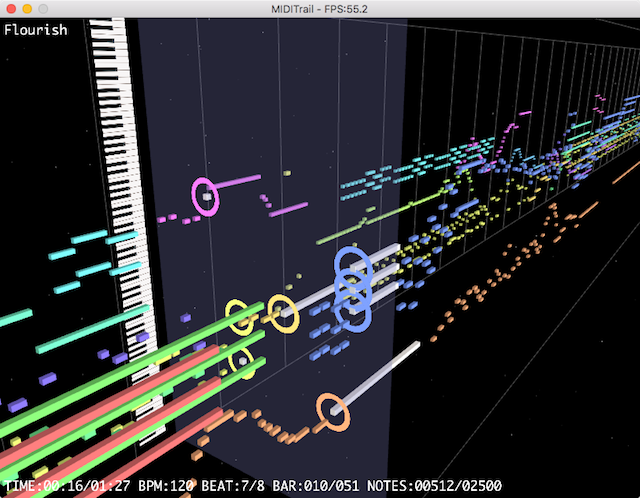
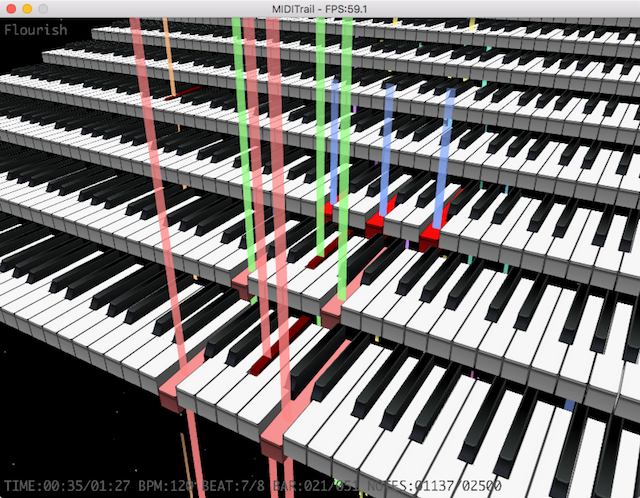
"MIDITrail" is a MIDI player which provides 3D visualization of MIDI datasets.
You can enjoy not only listening but also viewing.
MIDITrail supports SMF format 0/1, and multiple MIDI ports.
MIDITrail is available for Windows, macOS and iOS.
Screenshot: PianoRoll3D
Screenshot: PianoRollRain
2. System requirement
OS: macOS 10.13(High Sierra), 10.14(Mojave), 10.15(Catalina), 11(Big Sur), 12(Monterey), 13( Ventura), 14(Sonoma), 15(Sequoia), 26(Tahoe)
It is recommended that your Mac has high performance graphics for smooth animation.
If the MIDI datasets contains a lot of notes, the software needs more performance graphics.
As long as the performance of your Mac allows, please enjoy MIDITrail with large window.
3. How to get started
(1) How to install
There are two ways to install MIDITrail.
- Download MIDITrail from the App Store.
- Download the compressed file (MIDITrail-Ver.X.X.X-macOS.zip) from the MIDITrail website and extract it to a folder of your choice.
(2) MIDI OUT port settings
Click "MIDI OUT..." in the "Option" menu to display the MIDI OUT settings dialog.
You must configure the output destination for Port A.
(3) Playback midi files
Drag and drop a MIDI file (*.mid) into the MIDITrail window to open it.
Click the button on the operation panel to start playback.
4. Operation Panel
(1) Operation Panel
You can use the operation panel to control functions such as selecting and playing MIDI files and changing the viewpoint.
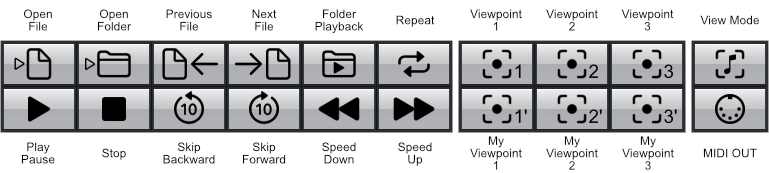
You can toggle the display of the operation panel by selecting "Operation Panel" from the "Window" menu.
Some MIDITrail functions cannot be accessed via the operation panel; please use the menu instead.
(e.g., MIDI IN monitor, saving viewpoints, various settings, viewing the manual)
5. Opening MIDI files
(1) Opening MIDI files
Clicking the "Open File" button on the operation panel will displays the file selection dialog,
where you can select a standard MIDI file (*.mid).
You can also open a file by dragging and dropping a standard MIDI file (*.mid) into the MIDITrail window.
You can also open a MIDI file upon launching MIDITrail by dropping the file onto the MIDITrail icon.
(2) Opening folder
MIDITrail can play MIDI files stored in a folder in sequence.
Clicking the "Open Folder" button on the operation panel will display a folder selection dialog,
where you can select the folder containing the Standard MIDI files (*.mid).
You can also open a folder by dragging and dropping it into the MIDITrail window.
(3) Command line interface
You can launch MIDITrail from the command line in the Terminal by specifying a MIDI file.
Note: Command-line usage is not available for the version of MIDITrail downloaded from the App Store.
open ./MIDITrail.app --args [-p] [-q] [path/to/file]
| argument | detail |
|---|---|
| -p | Play MIDI file after startup of MIDITrail. If you did not specify "path/to/file", this option will be ignored. |
| -q | End MIDITrail after end of playback. If option "-p" was not specified, this option will be ignored. |
| path/to/file | MIDI file path. When you specify a path including a space character, please use escape code. ex."file\ name.mid" |
6. Playback MIDI files
(1) Playback MIDI file
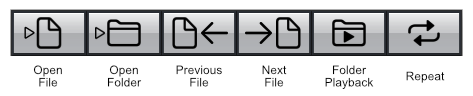
You can use the operation panel to start, pause, stop, and skip MIDI file playback, as well as change the playback speed.
When the "Repeat" button on the operation panel is selected, MIDITrail repeats the playback of the MIDI file.
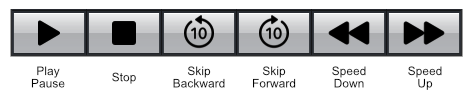
You can also control playback using menus, a keyboard, or a game controller instead of the operation panel.
(2) Folder playback
Opening the folder allows you to use the folder playback function.
Clicking the "Previous File" and "Next File" buttons on the operation panel allows you to open the files in the folder sequentially.
When the "Folder Playback" button is selected, MIDITrail automatically opens and begins playing the next file after the current MIDI file finishes playing.
When the "Repeat" button is selected, MIDITrail will start playing the first MIDI file after the last one finishes, thereby repeating the folder playback.
(3) Playback Counter
The contents of the playback counter displayed during MIDI file playback are as follows.
| Counter | Details |
|---|---|
| TIME | Elapsed time. |
| BPM | Tempo (Beats Per Minute). |
| BEAT | Time signature. |
| BAR | Number of bars. |
| NOTES | Number of notes. |
| SPEED | Playback speed. |
7. View Mode
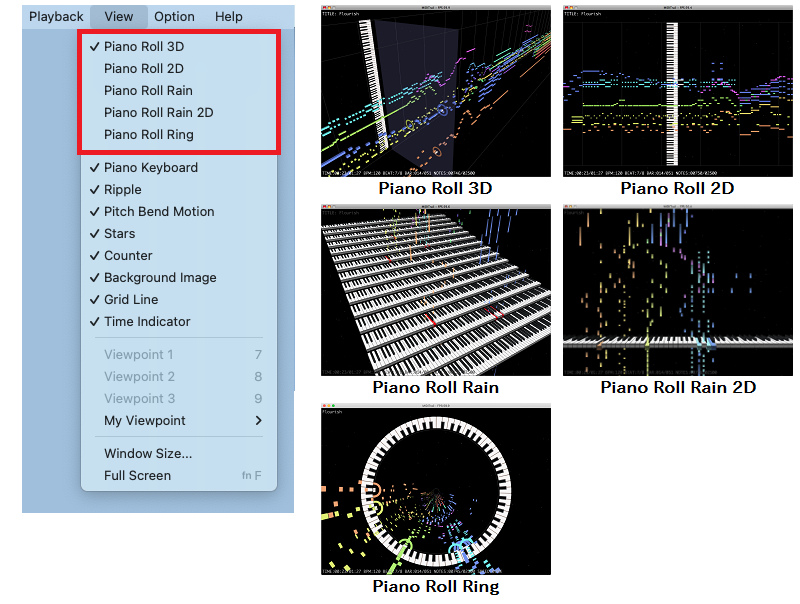
(1) Selecting the View Mode
Clicking the "View Mode" button on the operation panel will displays the view mode selection dialog, where you can select the view mode.
You can also select the view mode from the "View" menu. You can not change the view mode while playing or pausing.
(2) Display/Effect switch
You can switch the display/effect at the "View" menu.
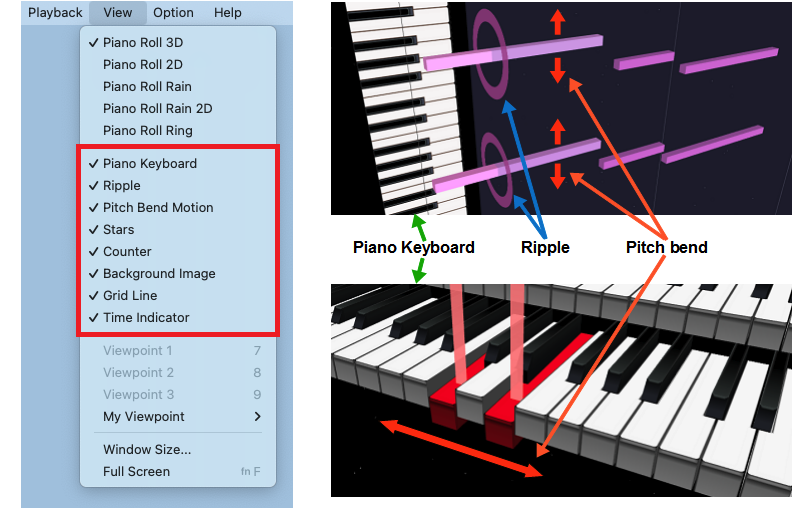
The piano roll bar will move up/down or right/left with change of pitch bend.
Some MIDI animation works are using pitch bend to shift the piano roll bars without change keys.
If the MIDI animation is not displayed correctly, please disable the pitch bend effect to fix the piano roll bars.
(3) Full screen display
When you select "Full Screen" from the "Window" menu, you can switch between window mode and full screen mode.
8. Moving the viewpoint
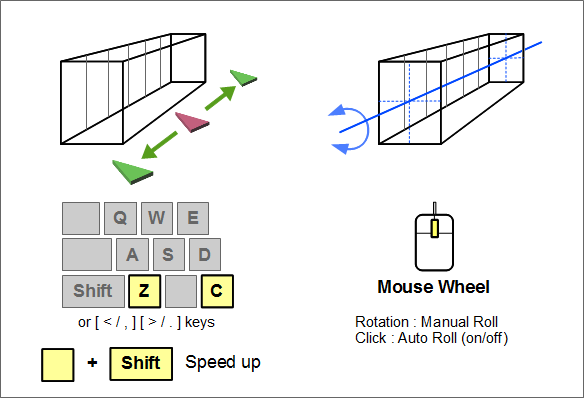
(1) Moving the viewpoint using the keyboard and mouse
You can move freely in 3D space, and look at MIDI datasets from all directions
by operation of keyboard and mouse, like FPS (First Person Shooter) game.
Although there is sense of incongruity in the beginning,
it will be very comfortable as experience is gained.
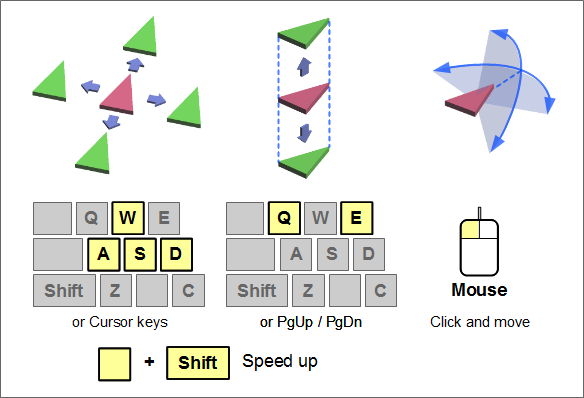
When you click the window, it will become the view control mode by the mouse,
and mouse cursor will disappear.
The eye direction synchronizes movement of your mouse.
If you click once again, view control mode will be canceled.
And you can rotate piano roll using mouse wheel.
(2) Moving the viewpoint using a game controller
You can operate the viewpoint with a game controller supported by macOS.
| Button / Stick | Action |
|---|---|
| Pause button | Play / Pause |
| A button | Play / Pause |
| B button | Stop |
| X button | Viewpoint: down |
| Y button | Viewpoint: up |
| L1/R1 shoulder button | Change viewpoint |
| L2/R2 trigger button | Skip back/forward |
| Directional pad | Viewpoint movement: front and back, right and left |
| Left thumbstick | Viewpoint movement: front and back, right and left |
| Right thumbstick | Eye direction |
(3) Switching and Saving Viewpoints
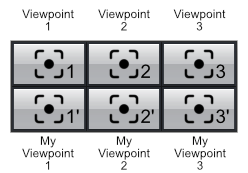
When you click "Viewpoint 1 / 2 / 3" button on the operation panel, you can switch to a standard viewpoint.
When you click "My Viewpoint 1 / 2 / 3" button, you can switch to a viewpoint saved in advance.
If you want to save the current viewpoint, select "Save My Viewpoint 1 / 2 / 3" from the "View" menu.
The viewpoint is saved for each view mode.
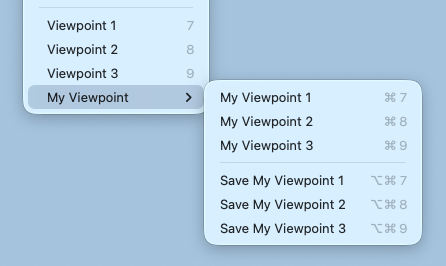
You can also use the keyboard to switch and save viewpoints.
9. MIDI IN monitor
You can view data sets received from MIDI IN device in realtime.
You need to select the device to be monitored in the MIDI IN settings beforehand.
When you select "Start Monitoring" from the "Playback" menu, MIDI IN monitoring will start.
NOTE: MIDITrail can not record data sets received from MIDI IN.
10. Setting
(1) Window size configuration
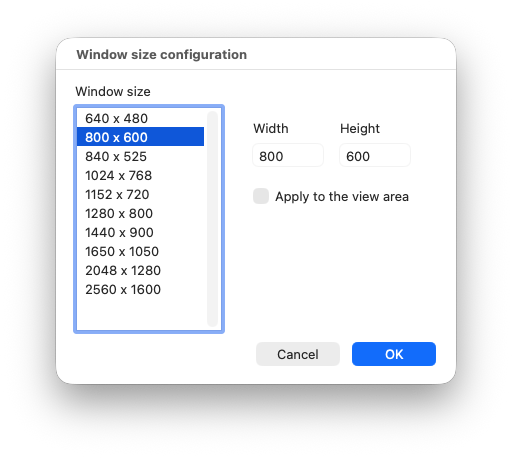
When you select "Window size..." from the "Window" menu, the window size configuration dialog will appear.
You can select your favorite window size.
You can not change window size while playing or pausing.
[Width] [Height]
You can specify any window size.
[Apply to the view area]
If you want to apply that size to the view area, check this option.
(2) MIDI OUT configuration
When you select "MIDI OUT..." from the "Option" menu, the MIDI OUT configuration dialog will appear.

[Port A]
At least, you must select the MIDI OUT device of "Port A". Ordinary MIDI datasets is sent to "Port A".
[Port B,C,D,E,F]
If you want to play the MIDI datasets which uses multiple ports,you must select the MIDI OUT device of port B, C, and so on.
To play the MIDI datasets which uses multiple ports, it is necessary to prepare MIDI interface and MIDI module which supports multiple ports.
(2) MIDI IN configuration
Select "MIDI IN..." from the "Option" menu, then "MIDI IN configuration" dialog will appear.
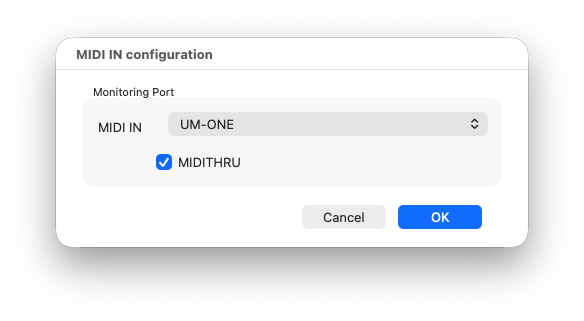
[MIDI IN]
Select the MIDI IN device to monitor.
[MIDITHRU]
If you check the MIDITHRU, MIDITrail will send data sets received from MIDI IN to MIDI OUT.
(3) Internal Wavetable Synthesizer configuration
Select "Synthesizer..." from the "Option" menu, the Internal Wavetable Synthesizer configuration dialog will appear.
You can not change Synthesizer configuration while playing or pausing.
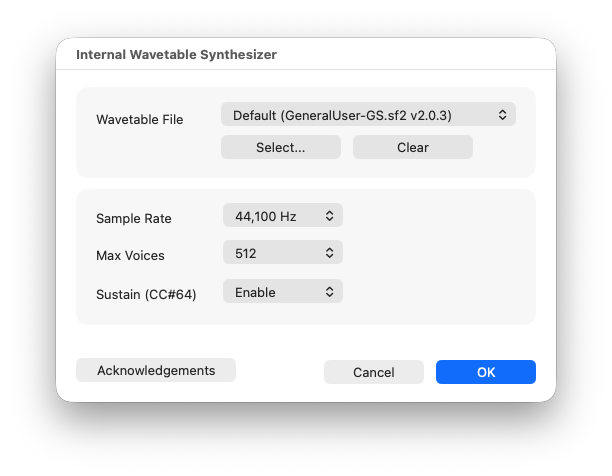
[Wavetable File]
The default value is the wavetable file (GeneralUser-GS.sf2) included with the app.
You can select your wavetable file.
The extension of the wavetable file must be ".sf2". MIDITrail does not support ".dls" files in version 2.1.0 and later.
MIDITrail assigns channel No.10 for percussion.
[Sample Rate]
Select the sample frequency for waveform rendering. The default value is 44100Hz.
[Max Voices]
Select the maximum number of voices for waveform rendering. The default value is 512.
Selecting a smaller value can reduce the load on the waveform rendering process,
but it may cause sound interruptions when playing MIDI data with a large number of notes.
[Sustain (CC#64)]
This setting allows you to choose whether or not to reflect the sustain (control change #64)
contained in the MIDI data in the waveform rendering process. The default value is enabled.
[Acknowledgements]
This displays copyright notices of the library and sound bank.
(4) Graphic configuration
Select "Graphic..." from the "Option" menu, the graphic configuration dialog will appear.
You can not change graphic configuration while playing or pausing.
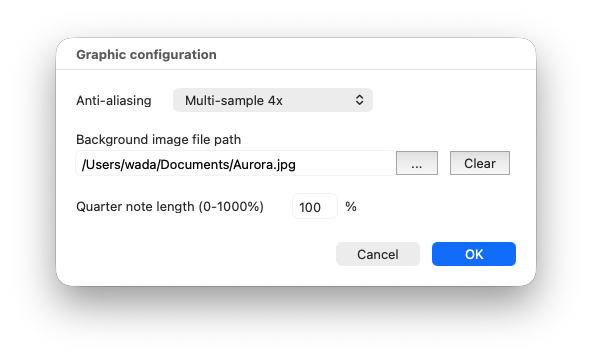
[Anti-aliasing]
If anti-aliasing is enabled, a notch (jaggy) will decrease and a more beautiful picture will be displayed.
However, since processing of anti-aliasing is heavy, performance may be poor when you select a upper level.
If your Mac does not support anti-aliasing, it is displayed as "Not supported".
[Background image file path]
If you want to display the background image, specify the file path of the image.
The extension of the image file must be ".jpg" or ".png".
MIDITrail supports a bitmap file that pixel format is 8bit RGB or 8bit RGBA.
[Quarter note length]
You can change a quarter note length of piano roll.
You can specify a value from 0% to 1000%. The default value is 100%.
(5) Color configuration
You can customize the colors displayed on the screen.
When you select "Color..." from the "Option" menu, the color configuration dialog will appear.
You can select the color palette and change it to your favorite color scheme.
You can not change the color while playing or pausing.
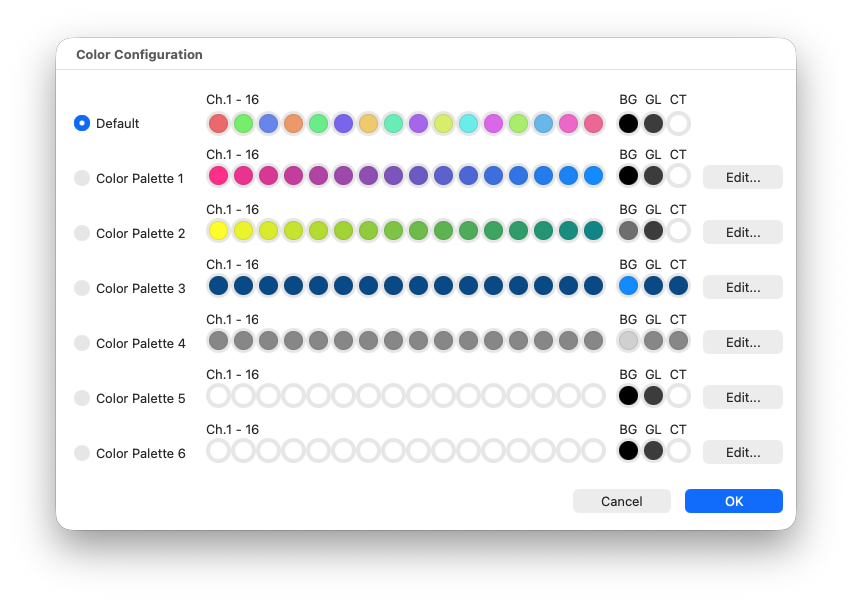
When you click "Edit..." button, the color palette configuration dialog will appear.
You can customize the color palette.
You can not edit the default color palette.
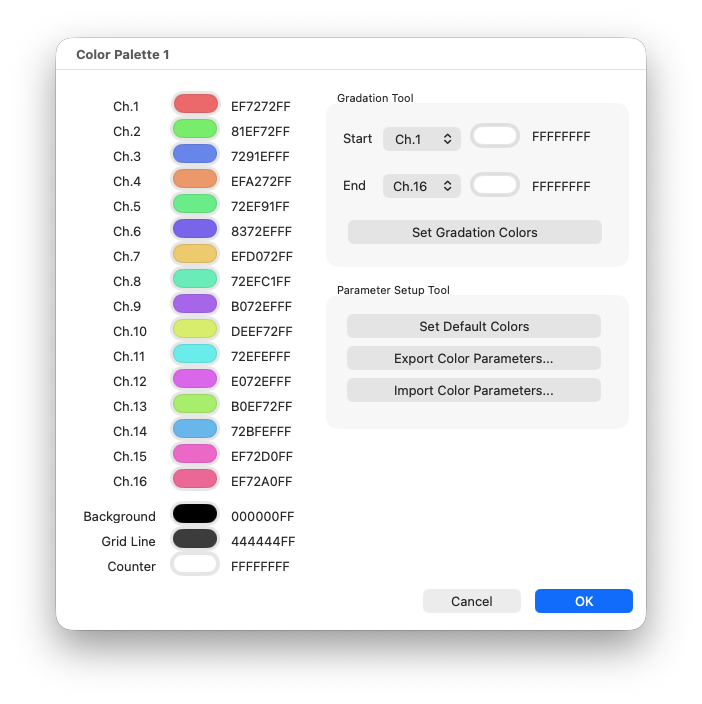
Gradation Tool
[Set Gradation Colors] You can assign gradation colors for channels that you selected.
Parameter Setup Tool
[Set Default Colors] Sets the default color for all items.
[Export Color Parameters...] You can edit the exported parameters with a text editor.
[Import Color Parameters...] You can import the parameters that you edited with a text editor. It is possible to enter part of the parameters.
11. Keyboard operations
(1) Keyboard operations
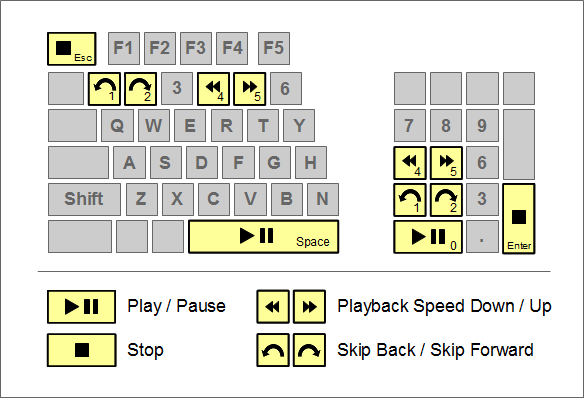
You can perform operations quickly using the keyboard. The keyboard operations for playing MIDI files are shown in the following figure.
(2) List of keyboard operations
| Kind | Key | Action |
|---|---|---|
| File | COMMAND + B COMMAND + P | Open previous file. |
| COMMAND + N | Open next file. | |
| Playback | SPACE | Play / Pause |
| ESC | Stop | |
| 12 | Skip Backward / Skip Forward | |
| 45 | Playback Speed Down / Up | |
| F2 | Double speed playback | |
| Moving Viewpoint (left hand) | WS | It moves forward and backward. |
| AD | It moves left and right. | |
| QE | It goes up and down. | |
| ZC | It moves along the direction of MIDI datasets. (In PinoRollRain, it moves along the piano keyboard.) | |
|
SHIFT + [WS] SHIFT + [AD] SHIFT + [QE] SHIFT + [ZC] |
Move quickly. | |
|
CTRL + [WS] CTRL + [AD] |
Control the direction of the gaze. | |
| Moving Viewpoint (right hand) | ↑↓ | It moves forward and backward. |
| ←→ | It moves left and right. | |
| PgUpPgDn | It goes up and down. | |
| ,. | It moves along the direction of MIDI datasets. (In PinoRollRain, it moves along the piano keyboard.) | |
|
SHIFT + [↑↓] SHIFT + [←→] SHIFT + [PgUpPgDn] SHIFT + [,.] |
Move quickly. | |
|
CTRL + [↑↓] CTRL + [←→] |
Control the direction of the gaze. | |
| Switching viewpoints | 7 | Move to standard viewpoint 3 |
| 8 | Move to standard viewpoint 2 | |
| 9 | Move to standard viewpoint 3 | |
| COMMAND + 7 | Move to my viewpoint 1 | |
| COMMAND + 8 | Move to my viewpoint 2 | |
| COMMAND + 9 | Move to my viewpoint 3 | |
| OPTION + COMMAND + 7 | Save my viewpoint 1 | |
| OPTION + COMMAND + 8 | Save my viewpoint 2 | |
| OPTION + COMMAND + 9 | Save my viewpoint 3 | |
| Screen | CTRL + COMMAND + F | Switching full screen |
12. Restriction
(1) Synchronization of MIDI sound and display
If you use the MIDI module which delays sound (such as software sound modules), the MIDI sound and display may not synchronize.
(2) Performance of graphics
MIDITrail renders all notes of the MIDI file in real time.
Therefore if MIDI file has a large number of notes, the load of rendering becomes high.
In order to enjoy MIDI file which contains tens of thousands of notes comfortably,
you have to use Mac which has high performance graphics.
(3) Multiple ports
In specification of SMF (Standard MIDI File), a method to select port is not defined.
However there is the unofficial method (*1) to select port.
MIDITrail supports that method, but may be unable to play the MIDI file.
It depends on the MIDI file.
(*1) Meta event (FF 21 01 pp) is the command to select port.
(4) Time format of standard MIDI file
MIDITrail can't open the MIDI file whose delta time represents actual time.
13. FAQ
(1) Q. Can I create playlists?
MIDITrail does not have a playlists function now, but you can use folder play function.
For details, please refer to "(2) Folder Playback" in "6. MIDI File Playback".
(2) Q. I want to generate video of MIDITrail. Does MIDITrail have recording function?
MIDITrail does not have a recording function now.
But you can use Quick Time Player to generate video files on macOS.
(1) Open Quick Time Player app, and choose "File" -> "New Screen Recording".
(2) Set the location where you want to save your screen recording.
(3) Click Record button. To stop recording, click the Stop Recording button in the menu bar.
Record your screen in QuickTime Player on Mac
https://support.apple.com/guide/quicktime-player/record-your-screen-qtp97b08e666/10.5/mac/12.0
(3) Q. The animation is not smooth.
Please try to change window size to small, and turn off anti-aliasing. Then the load of rendering becomes low.
Check FPS value in window title.
If the FPS value is under 60, the performance of graphics is insufficient.
When MIDI file has a large number of notes, the load of rendering becomes high.
To confirm the performance of your Mac, please try to open MIDI file which contains few notes.
If the animation does not improve, please use Mac which has high performance graphics.
(4) Q. I want to customize the window size and position.
You can customize the window size and position.
Please open following file by Property List Editor.
Property List Editor is a utility application of Xcode.
If you want to customize the window size, edit "Width" and "Height".
If you want to customize the window position, add "WindowPosition", "X" and "Y".
~/Library/Preferences/jp.sourceforge.users.yknk.MIDITrail.plist
View
    WindowSize
        Height=600 (Type:String)
        Width=800 (Type:String)
    WindowPosition
        X=100 (Type:String)
        Y=200 (Type:String)
14. How to customize
You can customize MIDITrail as your like, by editing the configuration files that were included in resources of MIDITrail.
| File | contents |
|---|---|
| MIDITrail.app/Contents/Resources/conf/Player.ini | Player configuration |
| MIDITrail.app/Contents/Resources/conf/PianoRoll3D.ini | View mode configuration: Piano Roll 3D |
| MIDITrail.app/Contents/Resources/conf/PianoRoll2D.ini | View mode configuration: Piano Roll 2D |
| MIDITrail.app/Contents/Resources/conf/PianoRollRain.ini | View mode configuration: Piano Roll Rain |
| MIDITrail.app/Contents/Resources/conf/PianoRollRain2D.ini | View mode configuration: Piano Roll Rain 2D |
| MIDITrail.app/Contents/Resources/conf/PianoRollRing.ini | View mode configuration: Piano Roll Ring |
| MIDITrail.app/Contents/Resources/conf/PianoRoll3DLive.ini | View mode configuration: Piano Roll 3D (MIDI IN monitor) |
| MIDITrail.app/Contents/Resources/conf/PianoRoll2DLive.ini | View mode configuration: Piano Roll 2D (MIDI IN monitor) |
| MIDITrail.app/Contents/Resources/conf/PianoRollRainLive.ini | View mode configuration: Piano Roll Rain (MIDI IN monitor) |
| MIDITrail.app/Contents/Resources/conf/PianoRollRain2DLive.ini | View mode configuration: Piano Roll Rain 2D (MIDI IN monitor) |
| MIDITrail.app/Contents/Resources/conf/PianoRollRingLive.ini | View mode configuration: Piano Roll Ring (MIDI IN monitor) |
If you want to open the resource files, right click MIDITrail icon, and select "Show Package Contents".
(1) Player Configuration
(a) Player Control
Edit [PlayerControl] section.
| Name | Details |
|---|---|
| AutoPlaybackAfterOpenFile | Playback automatically after opening file (0:disable / 1:enable) |
(b) View Control
Edit [ViewControl] section.
| Name | Details |
|---|---|
| ShowFileName | Show the file name instead of the title (0:disable / 1:enable) |
(c) Skip Control
Edit [SkipControl] section.
| Name | Details |
|---|---|
| SkipBackTimeSpanInMsec | Skip back time span (msec) |
| SkipForwardTimeSpanInMsec | Skip forward time span (msec) |
| MovingTimeSpanInMsec | Skip animation time span (msec) |
(d) Playback Speed Control
Edit [PlaybackSpeedControl] section.
| Name | Details |
|---|---|
| SpeedStepInPercent | Playback speed step (%) |
| MaxSpeedInPercent | Playback speed max ratio (%) |
(e) Playback Control
Edit [Playback] section.
| Name | Details |
|---|---|
| DelayBetweenSongsInMsec | Delay between songs (msec) (0 - 10000) |
(2) View Mode Configuration
(a) Moving speed of viewpoint
Edit [FirstPersonCam] section.
| Name | PR-3D/2D | PR-Rain/2D | PR-Ring | Details |
|---|---|---|---|---|
| VelocityFB | yes | yes | yes | Velocity of forward and backward. (m/s) |
| VelocityLR | yes | yes | yes | Velocity of left and right. (m/s) |
| VelocityUD | yes | yes | yes | Velocity of up and down. (m/s) |
| VelocityPT | yes | yes | yes | Angular velocity of look. (degree/s) |
| AcceleRate | yes | yes | yes | The rate of acceleration when push SHIFT key. (n times) |
| VelocityAutoRoll | yes | yes | yes | Angular velocity of auto rotation of piano roll (degree/s) |
| VelocityManualRoll | yes | yes | yes | Angular velocity of manual rotation of piano roll (degree/s) |
(b) Display of piano roll
Edit [Scale] section.
| Name | PR-3D/2D | PR-Rain/2D | PR-Ring | Details |
|---|---|---|---|---|
| QuarterNoteLength | yes | yes | yes | Length of quarter note (m) |
| NoteBoxHeight | yes | no | yes | Height of note box (m) |
| NoteBoxWidth | yes | no | yes | Width of note box (m) |
| NoteStep | yes | no | no | Interval length of notes in a channel (m) |
| ChStep | yes | no | yes | Interval length of channels (m) |
| RippleHeight | yes | no | yes | Height of ripple (m) |
| RippleWidth | yes | no | yes | Width of ripple (m) |
| PictBoardRelativePos | yes | no | yes | The relative position which crosses perpendicularly the board and the playback section. 0.0 - The left edge of board crosses playback section 0.5 - The center of board crosses playback section 1.0 - The right edge of board crosses playback section |
| LiveNoteLengthPerSecond | yes | yes | yes | Note length for 1 second in monitor (m) |
| LiveMonitorDisplayDuration | yes | yes | yes | Display duration in monitor (msec) |
| RingRadius | no | no | yes | Radius of ring (m) |
If you set small value to QuarterNoteLength, you can enjoy MIDI datasets like miniature garden.
(c) Color
Edit [Color] section. "A" of "RGBA" means alpha value.
| Name | PR-3D/2D | PR-Rain/2D | PR-Ring | Details |
|---|---|---|---|---|
| NoteColorType | yes | yes | yes | Note color type CHANNEL: Assign the channel color to the piano roll bar. (Ch-XX-NoteRGBA) SCALE: Assign the scale color to the piano roll bar. (Scale-XX-NoteRGBA) |
| Ch-01-NoteRGBA Ch-02-NoteRGBA : Ch-16-NoteRGBA | yes | yes | yes | Color of the piano roll bar at each channel.(RGBA) |
| Scale-01-NoteRGBA Scale-02-NoteRGBA : Scale-12-NoteRGBA | yes | yes | yes | Color of the piano roll bar at each scale.(RGBA) 01=C,02=C#,03=D,04=D#,05=E,06=F,07=F#,08=G,F09=G#,10=A,11=A#,12=B |
| GridLineRGBA | yes | no | yes | Color of the grid line and bar line. (RGBA) If A of RGBA is 00 then the grid line will disappear. |
| PlaybackSectionRGBA | yes | no | no | Color of the playback section. (RGBA) |
| CaptionRGBA | yes | yes | yes | Color of the caption/counter string.(RGBA) |
| BackGroundRGBA | yes | yes | yes | Back ground color(RGBA) |
(d) Active note effect
Edit [ActiveNote] section.
| Name | PR-3D/2D | PR-Rain/2D | PR-Ring | Details |
|---|---|---|---|---|
| Duration | yes | no | yes | Duration of active note flash.(msec) |
| WhiteRate | yes | no | yes | White rate at "NOTE ON". 0.0 Same color as piano roll bar. It means no flash. 0.5 Neutral color of piano roll bar and white. 1.0 White. |
| EmissiveRGBA | yes | no | no | Emissive color of active note. (RGBA) The parameter will be ignored on PianoRoll2D. The parameter has been deprecated since Ver.2.0.0. |
| SizeRatio | yes | no | yes | Size magnification ratio of active note. The parameter will be ignored on MIDI IN monitor. |
(e) Ripple
Edit [Ripple] section.
| Name | PR-3D/2D | PR-Rain/2D | PR-Ring | Details |
|---|---|---|---|---|
| Duration | yes | no | yes | Duration of a ripple.(msec) |
(f) Stars
Edit [Stars] section.
| Name | PR-3D/2D | PR-Rain/2D | PR-Ring | Details |
|---|---|---|---|---|
| NumberOfStars | yes | yes | yes | The number of stars to draw. |
(g) Bitmap
Edit [Bitmap] section.
Place your bitmap file to "data" folder which exists under the MIDITrail folder.
And write the bitmap file name to INI file.
If the height or width of bitmap is too big, your Mac may be unable to draw the bitmap.
In Mac OS X 10.5, if you use the image which size is not (2^n)*m, the texture may be broken.
| Name | PR-3D/2D | PR-Rain/2D | PR-Ring | Details |
|---|---|---|---|---|
| Board | yes | no | yes | Bitmap file name of the picture board.(ex. "data\Board.bmp") Instead of piano keyboard, you can display your favorite wallpaper. The aspect ratio of bitmap is arbitrary. To adjust the relative position which crosses perpendicularly the board and the playback section, please edit "[Scale] / PictBoardRelativePos". |
| Ripple | yes | no | yes | Bitmap file name of the ripple.(ex. "data\Ripple.bmp") You can change ripple which is displayed on "NOTE ON". The aspect ratio of bitmap is arbitrary. To adjust ripple display size, please edit "[Scale] / RippleHeight, RippleWidth". |
| Keyboard | no | yes | no | Bitmap file name of piano keyboard.(ex. "data\Keyboard.bmp") Texture image of Piano keyboard. You can not change the aspect ratio of this bitmap. |
(h) Piano keyboard
Edit [PianoKeyboard] section.
| Name | PR-3D/2D | PR-Rain/2D | PR-Ring | Details |
|---|---|---|---|---|
| KeyDownDuration | no | yes | no | Duration of key down (msec) |
| KeyUpDuration | no | yes | no | Duration of key up (msec) |
| KeyboardStepY | no | yes | no | Keyboard step interval: Horizontal direction (m) |
| KeyboardStepZ | no | yes | no | Keyboard step interval: Vertical direction (m) |
| KeyboardMaxDispNum | no | yes | no | The number of the maximum keyboards (0-16) |
| WhiteKeyColor | no | yes | no | Color of white key. (RGBA) |
| BlackKeyColor | no | yes | no | Color of black key. (RGBA) |
| ActiveKeyColorType | no | yes | no | Active key color type STANDARD: Standard color (ActiveKeyColor) NOTE: Note color (Ch-XX-NoteRGBA or Scale-XX-NoteRGBA) |
| ActiveKeyColor | no | yes | no | Color of active key. (RGBA) |
| ActiveKeyColorDuration | no | yes | no | Duration of change from the color of note ON to the last neutral color. (msec) |
| ActiveKeyColorTailRate | no | yes | no | Definition of the last neutral color. Color ratio of the color of note ON (red) and the color of key (white/black) (0.0-1.0) |
| KeyDispRangeStart | no | yes | no | Key display range: start position (0-127) In typical 88-key piano, start position is 21(A0). |
| KeyDispRangeEnd | no | yes | no | Key display range: end position (0-127) In typical 88-key piano, end position is 108(C8). |
(i) Picture board
Edit [Board] section.
If you want to draw the part of the image that specified at "Board" of [Bitmap] section,
set the rectangle parameters here.
| Name | PR-3D/2D | PR-Rain/2D | PR-Ring | Details |
|---|---|---|---|---|
| ClipImage | yes | no | yes | Clip image (0:no/1:yes) |
| ClipAreaX1 | yes | no | yes | Clipping area X1 |
| ClipAreaY1 | yes | no | yes | Clipping area Y1 |
| ClipAreaX2 | yes | no | yes | Clipping area X2 |
| ClipAreaY2 | yes | no | yes | Clipping area Y2 |
(j) Standard viewpoint
Edit [Viewpoint-2],[Viewpoint-3] section. You can not edit viewpoint 1.
| Name | PR-3D/2D | PR-Rain/2D | PR-Ring | Details |
|---|---|---|---|---|
| no | yes | yes | yes | X-coordinate |
| Y | yes | yes | yes | Y-coordinate |
| Z | yes | yes | yes | Z-coordinate |
| Phi | yes | yes | yes | Azimuth angle (degree) |
| Theta | yes | yes | yes | Zenith angle (degree) |
| ManualRollAngle | yes | yes | yes | Manual rotation angle (degree) |
| AutoRollVelocity | yes | yes | yes | Automatic rotation velocity (degree/second) |
15. Appendix
(1) Structure of 3D piano roll visualization
(a) The structure of "Piano roll 3D" visualization
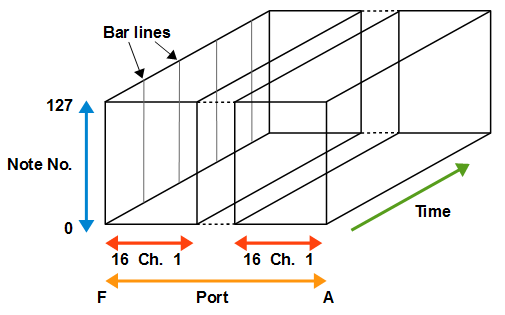
When MIDITrail open the MIDI datasets uses multiple ports, unused port will be not displayed.
For example, if the MIDI datasets uses port A, C and E,
MIDITrail displays port A, C and E side by side, and omits port B and D.
(b) The structure of "Piano Roll Rain" visualization
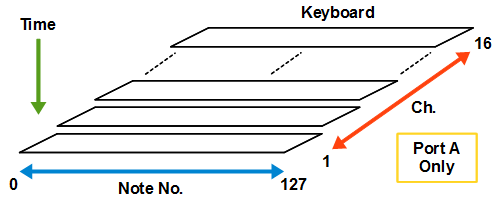
When MIDITrail open the MIDI datasets uses multiple ports,
only piano keyboards of port A will be displayed.
However piano roll bars of all ports will be displayed.
16. Copyright and license
WADA Masashi holds the copyright of MIDITrail.
MIDITrail is released under the BSD license.
Copyright (c) 2010-2026, WADA Masashi <
17. Acknowledgements
MIDITrail uses the following library and SoundFont bank.
TinySoundFont
Copyright (C) 2017-2023 Bernhard Schelling (Based on SFZero: Copyright (C) 2012 Steve Folta)
https://github.com/schellingb/TinySoundFont
License details
GeneralUser GS
Copyright (C) 1997-2025 S. Christian Collins
https://www.schristiancollins.com/
License details
18. History
osdn#<id> ... OSDN Ticket Archive
ghmac#<id> ... GitHub MIDITrail-macOS
| yyyy/mm/dd | Version | Changelog |
|---|---|---|
| 2010/10/21 | Ver.0.0.0 | Development start It based on the source code of MIDITrail Ver.1.1.1 for Windows |
| 2010/12/26 | Ver.1.1.2 | First formal release for Mac OS X osdn#23973 MIDITrail for Mac OS X development |
| 2011/12/25 | Ver.1.1.3 |
osdn#25454 Added grid line display control osdn#26985 Added Mac OS X 10.7 (Lion) support osdn#26987 Added playback speed control osdn#26988 Added skip control osdn#26989 Added stars and counter display control osdn#27005 Added figure of player operations guide to "How to view dialog" osdn#26990 Fixed bug (Typographical errors on the license) |
| 2012/02/12 | Ver.1.2.0 |
osdn#27458 Added MIDI IN monitoring osdn#27459 Added MIDI OUT auto configuration osdn#27457 Fixed bug (Screen flickers on skip forward when repeat ON) |
| 2014/01/02 | Ver.1.2.1 |
osdn#32544 Merged features of MIDITrail Ver.1.2.1 for Windows osdn#30545 Added key display range control osdn#30546 Added back ground color control osdn#30547 Added scale color assignment to the piano roll bar osdn#30549 Added improvement of font error message osdn#32543 Added window position control osdn#30550 Added support of virtual MIDI port osdn#30551 Added support of new line character LF in INI file osdn#32360 Added menu item "Auto save viewpoint" osdn#32361 Added ability to save viewpoint in MIDI IN monitoring osdn#32362 Added ability to playback automatically after opening file osdn#32363 Added ability to open the file while playing osdn#32366 Added ability to display the file name osdn#32367 Added view mode "Piano Roll Rain 2D" osdn#32427 Added note color assignment to active key osdn#32606 Added support of app sandbox osdn#32365 Changed title caption ("TITLE:" string was removed) osdn#32730 Changed development environment to Xcode 4 osdn#30548 Fixed bug (At the start of playback, MIDI data transmission is blocked) osdn#32359 Fixed bug (MIDITrail does not send some CC events at skip processing) osdn#32542 Fixed bug (MIDITrail fails to get the offline property of MIDI device) osdn#32779 Fixed bug (MIDI OUT device "none" does not take effect) |
| 2015/11/23 | Ver.1.2.2 |
osdn#35749 Fixed bug. (MIDITrail does not work in El Capitan) osdn#35750 Changed development environment to Xcode 7 (OS X Ver.) osdn#35751 Changed display of the security message for the sandbox osdn#35775 Changed URL and mail address in user's manual |
| 2017/07/23 | Ver.1.2.3 |
osdn#37373 Added supports window size customization osdn#37374 Added supports background image customization osdn#37375 Added increase of the size of active note osdn#37371 Changed architecture to 64bit osdn#37372 Changed development environment to Xcode 8 osdn#37376 Changed brightness the ripple color osdn#37377 Changed OS name to macOS on user manual osdn#37378 Fixed bug (Erased the item "Enter Full Screen" of "View" menu) osdn#37379 Fixed bug (Disable key input for main window while displaying setting dialog) |
| 2019/04/14 | Ver.1.2.4 |
osdn#39113 Added viewpoint selection menu osdn#39114 Fixed bug (Piano roll bar flickers in Piano Roll 2D mode) osdn#39115 Fixed bug (Time indicator becomes opaque in Piano Roll 3D mode) osdn#39116 Changed development environment to Xcode 9 |
| 2019/05/03 | Ver.1.2.5 |
osdn#39188 Added internal wavetable synthesizer osdn#39189 Added quarter note length configuration osdn#39190 fixed bug (memory leak of background image processing) osdn#39191 Changed appendix of user's manual |
| 2019/06/02 | Ver.1.2.6 |
osdn#39276 Added full screen mode osdn#39277 Added support for game controller osdn#39282 Fixed bug (Code analysis found some mistakes) osdn#39284 Fixed bug (Line feed code is not LF in some source files) |
| 2019/11/06 | Ver.1.3.1 |
osdn#39718 Added view mode "Piano Roll Ring" osdn#39719 Added supports dark mode osdn#39720 Changed development environment to Xcode 10 osdn#39721 Changed rendering loop to display link osdn#39722 Fixed bug (Error dialog must be displayed by main thread) osdn#39723 Fixed bug (Japanese is not detected) osdn#39726 Fixed bug ("Unsupported bitmap format" error displayed on launch) |
| 2021/04/02 | Ver.1.3.2 |
osdn#41895 Added support for macOS 11 Big Sur (Core MIDI new API) osdn#41896 Added support for Retina display osdn#41894 Changed development environment to Xcode 12 (Support M1 Mac) osdn#41903 Changed MIDI device identification rule osdn#41897 Fixed bug (The color of the ripples becomes dark in Piano Roll 3D) osdn#41898 Fixed bug (The character encoding of some source files is Shift-JIS) |
| 2021/05/23 | Ver.1.3.3 |
osdn#42364 Added Folder Playback feature osdn#42365 Added support for Standard MIDI File with illegal chunk size osdn#42366 Added support for RIFF-based MIDI File osdn#42367 Added sending "All Sound Off" message when pause/stop/skip osdn#42368 Fixed bug ("WARNING ITMS-90788" is displayed when uploading the app to App Store) osdn#42369 Fixed bug (MIDITrail does not start in virtual machine environment) |
| 2021/09/08 | Ver.1.3.4 |
osdn#42830 Added setting of delay between songs osdn#42831 Fixed bug (Sending System Exclusive causes crash when data size is zero) |
| 2022/02/13 | Ver.1.3.5 |
osdn#43853 Fixed bug (File Open Panel freezes) |
| 2022/07/18 | Ver.1.3.6 |
osdn#45144 Added feature of saving my viewpoint osdn#45145 Added display switch of grid line and time indicator osdn#45146 Added feature of saving display switch status osdn#45147 Added 2nd light for Piano Roll 3D osdn#45148 Added MIDI system message parsing |
| 2022/09/27 | Ver.2.0.0 |
osdn#45695 Added feature of color configuration osdn#45696 Added bar ring for Piano Roll Ring osdn#45697 Changed key color of Piano Roll Rain osdn#45698 Changed development environment to Xcode 13 osdn#45699 Changed graphics API from OpenGL to Metal osdn#45732 Changed app name animation in startup screen |
| 2022/10/26 | Ver.2.0.1 |
osdn#45971 Added function to send note off when paused or stopped and note on when resumed osdn#45972 Fixed bug (MIDITrail is not reading tempo data correctly) |
| 2022/10/30 | Ver.2.0.2 |
osdn#46016 Fixed bug (MIDITrail crashes during the Metal initialization process due to improper anti-aliasing settings) |
| 2026/01/15 | Ver.2.0.3 |
ghmac#1 Changed development environment to Xcode 26 ghmac#2 Changed documents due to the migration of the project website ghmac#3 Changed application icon ghmac#4 Fixed bug (MIDITrail crashes when loading a MIDI file with no notes) |
| 2026/06/28 | Ver.2.1.0 |
ghmac#5 Added TinySoundFont as the internal wavetable synthesizer ghmac#6 Added GeneralUser GS as the default wavetable file ghmac#7 Added Operation Panel ghmac#8 Added message incicating that files can be dropped on the startup screen ghmac#9 Added function to save the selection state of repeat and folder playback ghmac#10 Changed the default setting for the MIDI output device (Port A) to the internal wavetable synthesizer ghmac#11 Changed the initial display page of the manual ghmac#12 Changed the timing for saving color palette settings ghmac#13 Changed the manual chapter structure ghmac#14 Fixed bug (The display color in the color settings dialog is faint) ghmac#15 Fixed bug (Captions and background images may not render correctly in a multi-monitor environment) ghmac#16 Fixed bug (The device was not closed when monitoring started) ghmac#17 Fixed bug (The app is not waiting for the sequencer thread to finish) |